What are eye floaters? Causes, types, and when to worry
Eye floaters are those drifting specks and threads in your vision. Here's what they are, why they happen, and the warning signs that mean see a doctor today.
Eye floaters are those small, drifting specks, threads, or cobwebs that move across your field of vision — and seem to dart away when you try to look at them directly. They are surprisingly common: somewhere between one in three and three in four adults notice them, depending on how the question is asked.1 For most people, they are harmless and become less noticeable over time. For others, they are a constant, frustrating companion. This article explains what floaters actually are, why they happen, the warning signs that warrant urgent attention, and what to expect from a first visit to the eye doctor.
A note before we start
I am not a doctor. This article is written from a patient's perspective and is not a substitute for professional medical care. If you suddenly notice new floaters, flashes of light, or a shadow drifting across your vision, see an ophthalmologist the same day — or go to your nearest emergency department (in the US dial 911, in the UK 111 or A&E).
What’s actually going on inside the eye
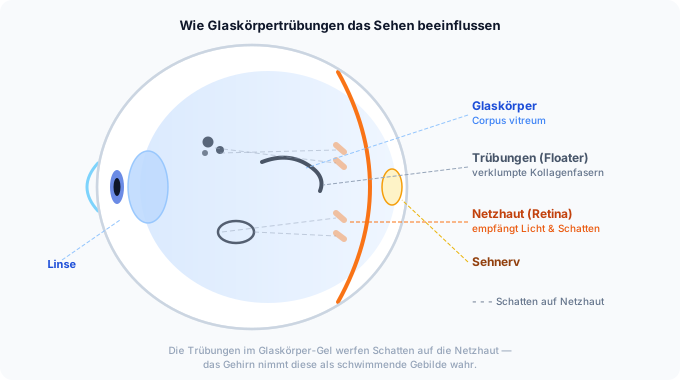
The space between the lens at the front of your eye and the retina at the back is filled with a clear gel called the vitreous body (or simply vitreous). The gel is about 98 % water, held in shape by a fine mesh of collagen fibers.2 Light passes through it on its way to the retina, where photoreceptors convert it into the signals your brain assembles into vision.
A floater is a small, opaque clump suspended inside this gel — usually a tangle of collagen fibers, but sometimes cellular debris, red blood cell fragments, or remnants of the embryonic hyaloid artery that ran through the vitreous before birth. When light passes the clump on its way to the retina, the clump casts a shadow onto the photoreceptors. Your brain interprets the shadow as a drifting shape in your visual field.
Two features distinguish floaters from most other visual phenomena:
- They move with your eye. Because the floater is inside the vitreous, it moves when your eye moves, then drifts as the gel itself settles.
- They are easier to see against bright, uniform backgrounds. A white screen, a clear blue sky, or a snowy landscape provides high contrast that makes the shadow stand out. Against complex backgrounds, the brain filters most floaters out.
The most common types
Floaters come in different shapes, and the shape often gives a hint about the underlying cause:
- Dots and specks — small, often multiple, drifting independently. Common at any age, often idiopathic (no clear cause).
- Threads and strands — longer, fibrous shapes. Typical of collagen-fiber aggregations in the aging or myopic vitreous.
- Rings or arcs — usually a single, larger floater that forms when the vitreous separates from the retina at the optic nerve. This is called a Weiss ring and is a classic sign of posterior vitreous detachment.
- Cobwebs or nets — irregular meshes of fibers, often associated with higher myopia.
- Smudges or clouds — denser regions that blur a part of the vision rather than appearing as discrete shapes.

Why floaters appear
There is no single cause. Several different mechanisms can produce floaters, and most people develop them through a combination of these factors.
Aging (vitreous syneresis and PVD)
With age, the vitreous gel gradually liquefies — a process called syneresis. Pockets of liquid form within the gel, and collagen fibers that were once spread evenly start to clump together. These clumps are the most common source of floaters in adults over 40.
Eventually, the vitreous shrinks enough to pull away from the retina at the back of the eye. This event is called a posterior vitreous detachment (PVD). It usually happens between ages 50 and 70 and is one of the most common reasons people suddenly notice new floaters and brief flashes of light. A PVD is not dangerous in itself — but in a small number of cases, the vitreous tugs hard enough on the retina to cause a tear, which can lead to retinal detachment. That is why any sudden change in floaters deserves a same-day eye exam.
Myopia (nearsightedness)
In a myopic eye, the eyeball is longer than average. This stretches the vitreous and accelerates the liquefaction process. People with significant myopia (roughly −3 diopters and beyond) often develop floaters 10 to 20 years earlier than people with normal vision, and tend to have more of them.3 If you started seeing floaters in your 20s or 30s and you wear glasses for distance, myopia is the most likely explanation.
Posterior vitreous detachment, in detail
PVD is worth a closer look because it accounts for a large fraction of new-onset floaters in adults. As the gel separates from the retinal surface, it can release a particularly visible floater — often the Weiss ring mentioned above, formed where the vitreous was attached around the optic nerve. Many patients also see brief flashes of light at the edge of their vision in the days before and after a PVD, caused by mechanical tugging on the retina.
In most cases, a PVD completes without complication. The flashes settle within weeks; the new floater either drifts out of the central field of view or fades from conscious awareness over months.
Other causes
A smaller share of floaters has more specific medical causes:
- Uveitis — inflammation inside the eye that releases cells into the vitreous. Often comes with light sensitivity, redness, or pain.
- Vitreous hemorrhage — bleeding into the vitreous, often after trauma, in advanced diabetes, or after a retinal tear. The floaters tend to be dense, dark, and sudden.
- Asteroid hyalosis — calcium-phosphate particles suspended in the vitreous. Usually painless and present in one eye; often discovered on a routine exam rather than reported as a complaint.
- Eye trauma — a blow to the eye can dislodge collagen fragments or cause small bleeds, producing new floaters.
- Post-surgical floaters — cataract surgery and intravitreal injections can sometimes trigger or worsen floaters.
Warning signs that mean see a doctor today
Most floaters are harmless. But because the vitreous and the retina are mechanically linked, certain symptoms suggest something more urgent.
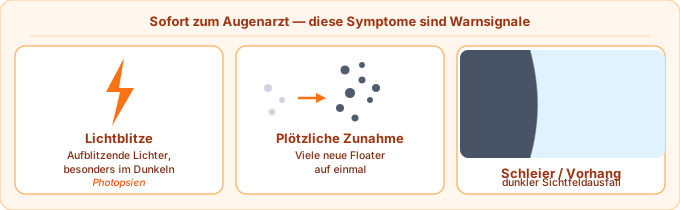
Seek same-day evaluation — an ophthalmologist’s office, an eye emergency clinic, or your nearest emergency department — if you experience any of the following:
- A sudden shower of new floaters — many small black dots appearing at once, often described as “a swarm of gnats” or “soot”
- Flashes of light (called photopsia), especially repeated brief flashes at the edge of vision in dim conditions
- A shadow, curtain, or veil falling across part of your visual field
- A sudden drop in visual clarity that isn’t explained by your usual prescription
These can indicate a retinal tear, retinal detachment, or vitreous hemorrhage — all of which respond well to early treatment but cause permanent damage if left for days. A 2009 systematic review found that around 14 % of patients with acute-onset floaters and flashes had a retinal tear at the first examination, so it is not a rare association.4
If you can’t reach an ophthalmologist quickly:
- United States — call 911 or go to your nearest emergency department; ask for an ophthalmology consult
- United Kingdom — call NHS 111 or go to A&E; many hospitals have eye casualty clinics with same-day appointments
- Canada / Australia / most of Europe — equivalent local emergency lines (e.g., 000 in Australia, 112 across the EU)
The exam takes about 20–30 minutes and is straightforward: dilating drops, a slit-lamp inspection, and a careful look at the peripheral retina with an indirect ophthalmoscope.
What an eye exam looks like
If you’ve never had your eyes dilated, here is what to expect:
- History. The doctor asks when the floaters started, how they have changed, and whether you have noticed flashes, shadows, or recent injury. Past eye history (myopia, surgeries) matters too.
- Vision and pressure check. Standard tests of visual acuity and intraocular pressure.
- Dilation. Drops are placed in each eye. Within 20–30 minutes, the pupils widen so the doctor can see the entire retina and vitreous.
- Slit-lamp and ophthalmoscopy. The doctor inspects the front of the eye and then the back, often using a lens held close to the eye while shining a bright light. Bring sunglasses — your eyes will be sensitive to light for 4–6 hours afterward, and reading or driving will be uncomfortable.
- Conversation. The doctor describes what they found, whether the floaters need follow-up, and what warning signs to watch for at home.
For uncomplicated floaters, the result is usually reassurance and a list of warning signs to act on. For a posterior vitreous detachment, the doctor may recommend a follow-up exam in 4–6 weeks to confirm the retina has settled. For a tear or detachment, treatment (laser, cryotherapy, or surgery) is arranged the same day or the next.
What happens after the exam
If everything looks healthy, you have a useful baseline:
- You now know that your floaters are benign.
- You know what symptoms would change that picture (new flashes, sudden shower, curtain).
- You have a baseline against which any future change can be compared.
For most patients, the next steps are not medical — they are adjustment. Floaters tend to bother people most in the first weeks to months, when the visual system has not yet learned to filter them out. Some practical points on living with floaters are covered in Living with eye floaters. If the floaters are taking a serious toll on your mood or daily life, the article Floaters and mental health discusses what helps — and what does not.
If you are considering whether a treatment makes sense, the Treatment options article weighs the three main paths: watchful waiting, YAG laser vitreolysis, and vitrectomy.
A personal note
I started seeing my own floaters in my early 30s — a single thread that jumped with my gaze on a bright day at the screen. The first three weeks were the hardest, and most of that was the head, not the eye. I read forums (a mistake), saw two ophthalmologists for reassurance (a good decision), and slowly understood that this was anatomy, not a defect.
If I could pass one thing on to someone reading this for the first time: get a thorough exam to rule out anything urgent, then give your brain time before deciding anything else. Most of us live with floaters more comfortably than we believe we will at the start.
More about why I built this site on the About page.
Frequently asked questions
Are eye floaters normal?
Yes — for most people, occasional floaters are part of normal aging of the eye. Clinical studies find that about one in three adults perceive them; questionnaire-based surveys put the number as high as 76 %. They become more common from your 40s onwards, and earlier if you are nearsighted (myopic). What matters is not whether you have floaters, but whether they appear suddenly, increase rapidly, or come with flashes of light or a shadow across your vision — those are warning signs.
What exactly is a floater made of?
A floater is a tiny cluster of collagen fibers, cellular debris, or other microscopic material drifting in the vitreous body — the gel-like substance that fills most of the eye. When light passes through the eye, these clusters cast a shadow on the retina. Your brain interprets the shadow as a drifting speck, thread, or cobweb.
Can eye floaters go away on their own?
Sometimes — but rarely completely. Floaters can drift downwards out of the central field of vision over weeks to months. The vitreous can also shrink, pulling some floaters away from the visual axis. More commonly, the brain adapts: it filters the floater out of conscious perception, a process called neural adaptation. The floater is still there, but your visual system stops flagging it. Both effects take time, sometimes years.
Do floaters mean something is wrong with my eyes?
Usually not. Most floaters are caused by normal age-related changes in the vitreous. However, a sudden burst of new floaters — particularly with flashes of light, a curtain across the vision, or rapid loss of clarity — can indicate a retinal tear or detachment, which is a medical emergency.
Can lifestyle, diet, or screen time cause floaters?
No — there is no credible evidence that diet, hydration, stress, screen time, or specific activities cause floaters. The myth that floaters increase with screen use comes from the fact that bright, uniform backgrounds make existing floaters more visible. The floaters themselves do not change.
How does an eye doctor diagnose floaters?
An ophthalmologist will dilate your pupils with eye drops and examine the retina and vitreous using a slit lamp and an indirect ophthalmoscope. This rules out tears, detachments, bleeding, or inflammation. The exam typically takes 20–30 minutes, and your vision will be blurry for a few hours afterward — bring sunglasses and avoid driving.
Sources
Footnotes
-
Milston R, Madigan MC, Sebag J. Vitreous floaters: Etiology, diagnostics, and management. Survey of Ophthalmology. 2016;61(2):211–227. doi:10.1016/j.survophthal.2015.11.008 ↩
-
Sebag J. Vitreous and Vision Degrading Myodesopsia. Progress in Retinal and Eye Research. 2020;79:100847. doi:10.1016/j.preteyeres.2020.100847 ↩
-
Hayreh SS, Jonas JB. Posterior vitreous detachment: clinical correlations. Ophthalmologica. 2004;218(5):333–343. doi:10.1159/000079476 ↩
-
Hollands H, Johnson D, Brox AC, Almeida D, Simel DL, Sharma S. Acute-onset floaters and flashes: is this patient at risk for retinal detachment? JAMA. 2009;302(20):2243–2249. doi:10.1001/jama.2009.1714 ↩